Table of Contents
- 1.Common reasons a bill goes wrong
- 2.Step 1: Check your bill online first
- 3.Step 2: Read your own meter
- 4.Step 3: Compare against your history
- 5.Step 4: Understand a detection bill
- 6.Step 5: File a complaint with your DISCO
- 7.Step 6: Escalate to NEPRA if needed
- 8.Overbilling versus underbilling
- 9.Why the due date matters
- 10.Frequently asked questions
- How do I know if my electricity bill is wrong?
- What should I do first about a wrong bill?
- Can a detection bill be cancelled?
- Where do I complain about an overbilled electricity bill?
- Should I pay a bill I think is wrong before the due date?
- Can I check an old bill to compare my usage?
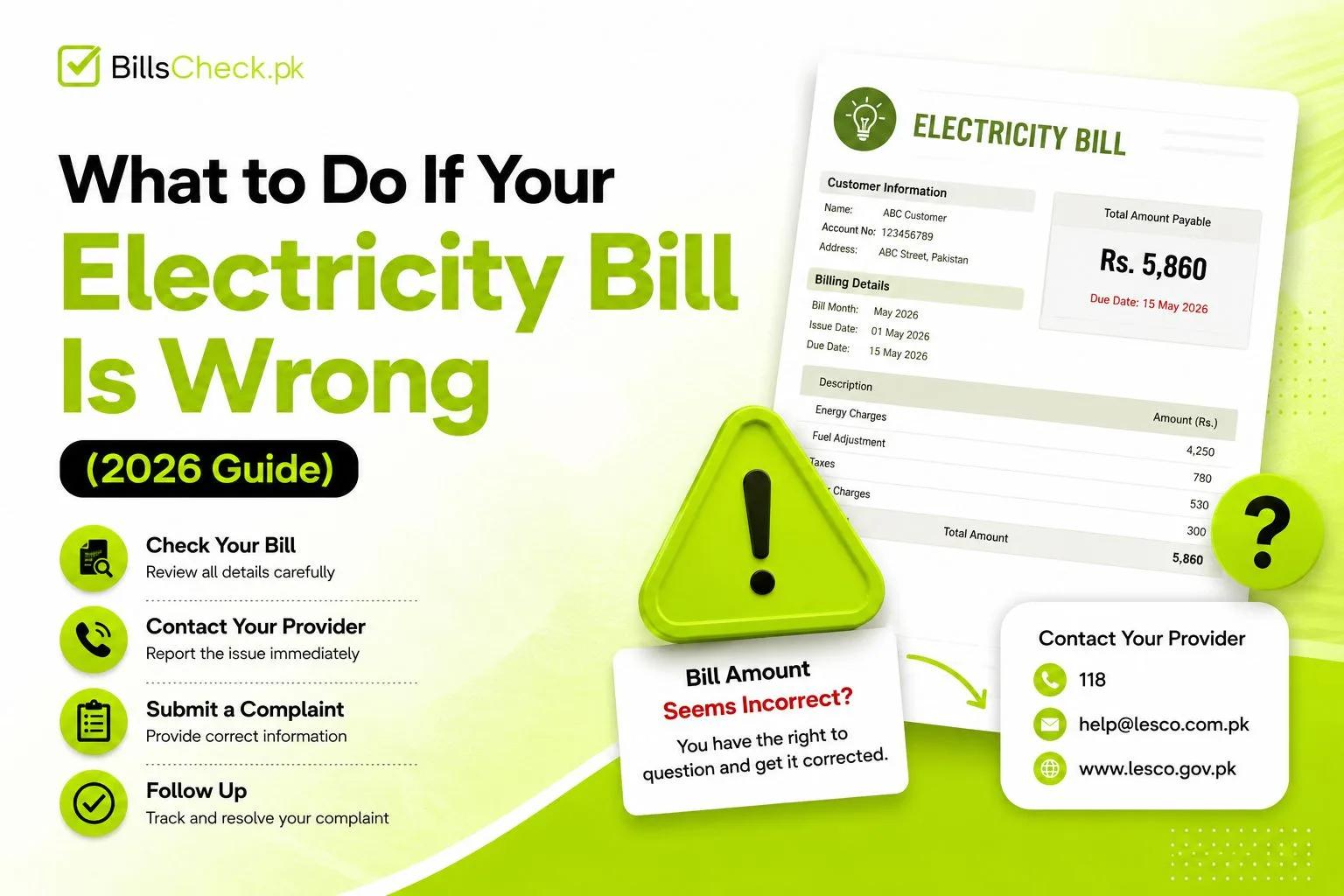
A wrong electricity bill is fixable, but only if you act before the due date. Overbilling is common in Pakistan, and it shows up as an estimated reading, a wrong meter reading, a detection charge added in error, or the wrong tariff category. The good news is that every distribution company, from LESCO to QESCO, has a complaint process, and NEPRA sits above them as the regulator. This guide shows how to spot the exact error, gather your proof, and file a complaint that gets the bill corrected. You will learn how to read your meter, compare your units against history, deal with a detection bill, and escalate if the DISCO drags its feet. Start by opening your bill online with your 14-digit reference number the moment it is issued.
Common reasons a bill goes wrong
Knowing the cause points you to the fix, so start by naming the error. Most wrong bills fall into a handful of types.
- Estimated reading, where the meter reader did not visit and the company guessed the units.
- Wrong meter reading, where the digits were misread or entered incorrectly.
- Detection charge, added when the company claims your meter under-recorded usage.
- Wrong tariff category or slab, which applies a higher rate than you should pay.
- Arrears error, where a paid amount still shows as outstanding.
- Faulty or dead meter, which produces a jump or a flat estimate.
Step 1: Check your bill online first
Checking the bill is the first move, because the detail you need is on it. Open your bill on your company page with the reference number, and read four figures: the units consumed, the current reading, the previous reading, and the amount payable. Compare the current and previous readings against the digits on your actual meter. You can open your bill for LESCO, MEPCO, FESCO, IESCO, GEPCO, PESCO, TESCO, HAZECO, HESCO, SEPCO or QESCO from its page and print a copy for your record.
Step 2: Read your own meter
Reading the meter yourself settles most disputes fast. Walk to the meter, note the current reading, and compare it against the current reading printed on the bill. If the bill reading is higher than what the meter shows, the company over-read or estimated the units, and you have clear grounds for a correction. Take a clear, dated photo of the meter display. That photo is your strongest piece of evidence when you raise the complaint.
Step 3: Compare against your history
History tells you whether the jump is real. Line up this month's units against last month and against the same month last year. A summer bill is naturally higher than a winter one, so compare like with like. If the units doubled with no new appliance, no extra occupants and no weather change, the reading is likely wrong. Keep the last few bills together, since a clear pattern makes your case obvious to the complaint officer.
Step 4: Understand a detection bill
Detection bills need special care, because they are the hardest to reverse. A detection charge is raised when the company alleges your meter recorded less than your true usage, often after a meter inspection. The company must show the basis for the charge, including the inspection report and the calculation. Ask for that report in writing. If the company cannot justify the units or the period it charged, the detection bill can be challenged and reduced or cancelled through the complaint process.
Step 5: File a complaint with your DISCO
Filing the complaint is where the correction actually happens. Call your company helpline first and note the complaint number they give you. Then visit the divisional or subdivision office with your reference number, the disputed bill, your meter photo and any past bills. Ask for a written acknowledgement of the complaint. Do this before the due date, since paying late adds a surcharge, and in a genuine dispute you can ask the office how to handle payment while the complaint is open.
Step 6: Escalate to NEPRA if needed
Escalation is your route when the DISCO does not resolve the matter. If the company rejects a valid complaint or ignores it, you can take the dispute to NEPRA, the national regulator, which handles consumer complaints against distribution companies. Submit your reference number, the disputed bills, your meter evidence and the DISCO complaint number. Keep copies of everything you send. A documented file, built from the steps above, is what moves a stubborn case forward.
Overbilling versus underbilling
Both directions matter, though people only notice one. Overbilling charges you for units you did not use, and you claim the correction as above. Underbilling, where the meter or reading understates your usage, sounds like a win, but it often returns later as a detection bill for the missed units. So if your bill looks oddly low, check the reading too, and keep your own record. That record protects you if the company later claims arrears.
Why the due date matters
Timing decides how smoothly the fix goes. Raise the dispute before the due date so you avoid the late payment surcharge that a delayed bill adds. A complaint filed early, with a reference number and a meter photo, is far easier to resolve than one raised weeks after the bill was due. Checking your bill online as soon as it is issued gives you the days you need to act.
Frequently asked questions
How do I know if my electricity bill is wrong?
Compare this month's units against last month and the same month last year, then match the bill's current reading to your actual meter. A sharp rise with no change in usage, or a bill reading higher than the meter, points to an estimated or wrong reading. Photograph the meter as proof.
What should I do first about a wrong bill?
Open the bill online with your 14-digit reference number and read the units, the current reading and the previous reading. Then check those readings against your actual meter. This confirms whether the error is a wrong reading, an estimate or a detection charge before you complain.
Can a detection bill be cancelled?
Yes, a detection bill can be reduced or cancelled if the company cannot justify it. Ask in writing for the inspection report and the calculation behind the charge. If the basis, the units or the period is wrong, challenge it through the DISCO complaint process and, if needed, escalate to NEPRA.
Where do I complain about an overbilled electricity bill?
Complain first to your distribution company, whether that is LESCO, MEPCO, PESCO or another DISCO, by calling the helpline and visiting the divisional office with your evidence. If the company does not resolve it, escalate the dispute to NEPRA with your complaint number and documents.
Should I pay a bill I think is wrong before the due date?
Raise the complaint before the due date first, and ask the DISCO office how to handle payment while the dispute is open. Paying late adds a surcharge, so acting early protects you. In a clear overbilling case the office can guide you on the disputed amount.
Can I check an old bill to compare my usage?
Yes, your past bills open with the same reference number you use for the current month, so you can pull them online and compare units side by side. A run of recent bills makes a jump easy to prove when you file the complaint.
Act early, keep your reference number and meter photo ready, and build a simple file of bills before you complain. To cut future bills once yours is corrected, read our guide on how to reduce your electricity bill in Pakistan, and learn how rates work in understanding electricity tariff slabs.